The Asset-Level Blind Spot in Commercial Auto Insurance Monitoring
July 21, 2026
Modern logistics compliance platforms have promised a golden era of automation: continuous monitoring, instant verification, and an end to manual compliance checkpoints. For freight brokers, shippers, and 3PLs, the idea of a hands-off, “real-time” insurance validation engine is incredibly attractive.
But behind the curtain of modern tracking networks lies a systemic friction point that the industry rarely discusses: the dangerous distinction between top-level policy validation and true asset-level visibility.
The Illusion of Automation in Commercial Auto
When an insurance tracking platform marks a motor carrier as “compliant,” it usually means the system has successfully verified top-level policy data. It confirms that a valid, active $1M Auto Liability or Cargo policy exists within an insurance agency’s system.
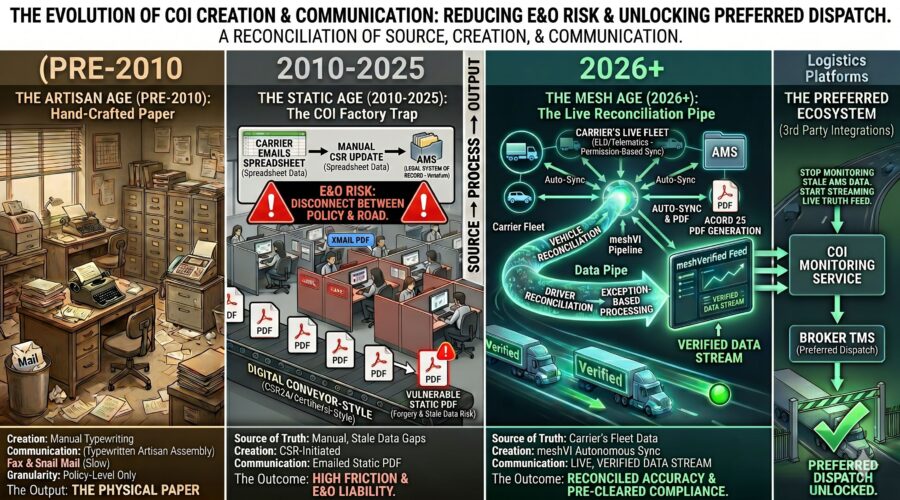
However, commercial auto insurance is uniquely complex because risk doesn’t exist at the macro policy level—it exists at the pavement level. What matters at the point of dispatch is precisely which scheduled Vehicle Identification Numbers (VINs) and drivers are legally bound to that coverage.
Because legacy Agency Management Systems (AMS) were originally engineered for static property and slip-based risk, their external digital integrations frequently stop at the top line. To bridge the gap down to individual vehicles, tracking workflows regularly degrade back into manual intervention.
Compliance platforms are forced to send manual requests to retail agency desks, creating friction for agents who must then copy, paste, and manually verify VIN updates and driver schedules onto certificates. The process appears automated on the surface, but it is driven by hidden administrative labor behind the scenes.
Moving From Policy-Level to Asset-Level Intelligence
True supply chain security requires moving past static policy verification and transitioning to continuous asset-level tracking. When monitoring networks only look at the macro policy, supply chain participants remain exposed to mid-term schedule changes—such as a specific vehicle being dropped from a policy or an unapproved driver taking the wheel.
Resolving this operational bottleneck isn’t about replacing current compliance networks; it’s about upgrading the data pipelines that feed them.
By introducing a dedicated, source-verified infrastructure layer that maps live physical fleet changes directly to insurance underwriting records, the entire transportation ecosystem wins. Compliance and monitoring networks gain the missing data granularity they need to automate validation fully, retail agencies eliminate manual paperwork loops, and logistics providers can finally dispatch freight with absolute exposure certainty.
Meet with meshVI CEO Andy Sharpe at the upcoming ATA Legal Forum to discuss post-Montgomery compliance and ensure your commercial auto insurance is up to date. Click the link below to book a 15-minute slot on his calendar.